Why is Sydney Derby no longer the hottest ticket in town?
This Saturday night’s Sydney Derby at Commbank Stadium will be the 42nd in the history of what has become one of the premier events on the A-League calendar.
Since the introduction of the Western Sydney Wanderers in 2012, they have battled Sydney FC in front of some of the biggest crowds domestic football has ever seen in Australia.
This week, as always, social media has been awash with nostalgia from the halcyon days of the fixture, when all of Sydney used to stop and take note of a match that even outdrew AFL finals between the Swans and the Giants at its very peak.
Win a free year of beIN SPORTS! Tap here to enter now >
These days, the crowds are healthy, but you can make a case that the Sydney Derby is no longer the hottest ticket in town.
If you track attendances since its inception, a clear picture forms.
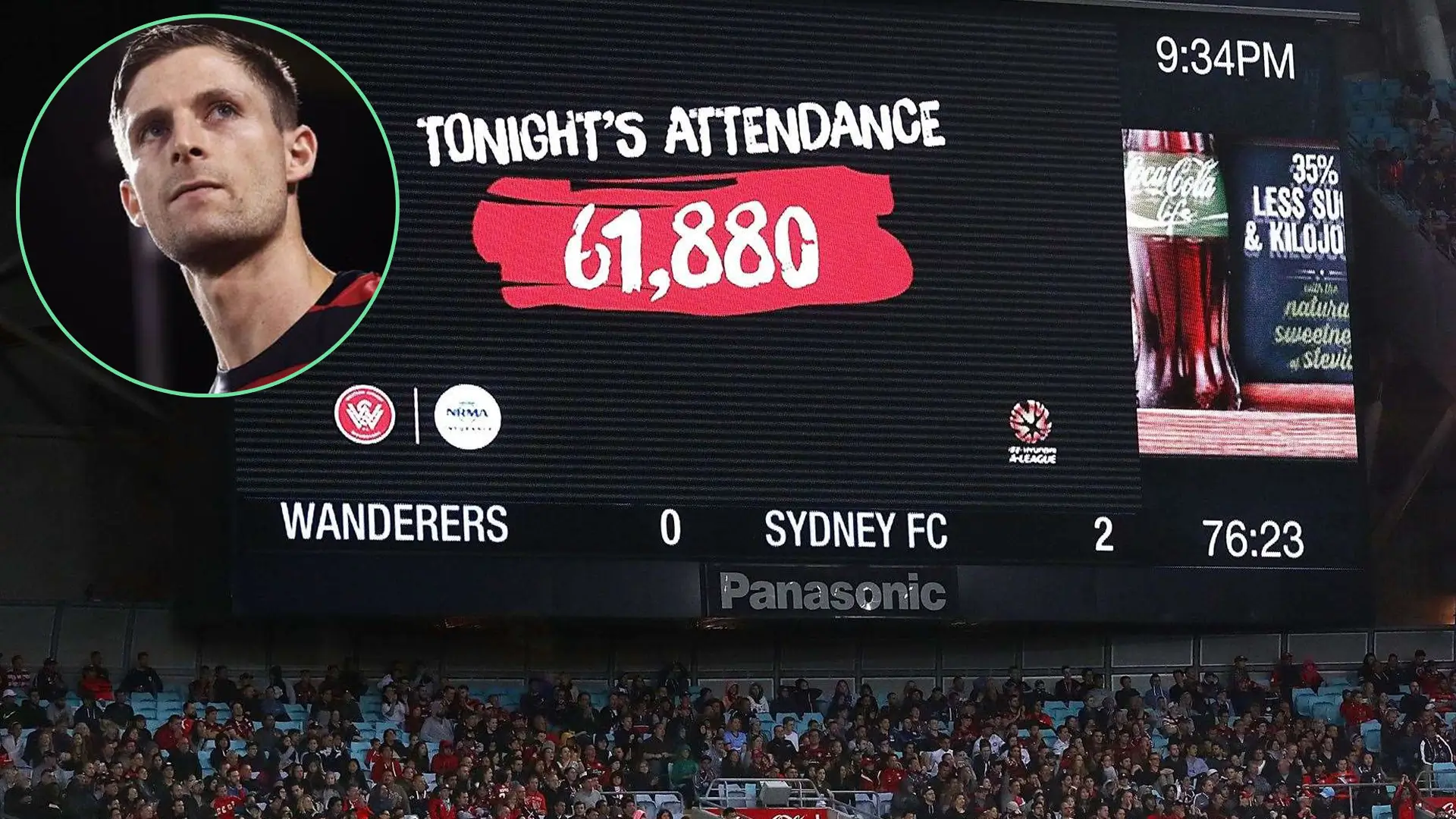
12 of the first 14 iterations of the clash were sellouts, whether they were hosted in Parramatta or Moore Park. In fact, the demand became so great, the match was moved to Stadium Australia on multiple occasions, with 61,880 fans packing the house in late 2016.
Some nine years on, that remains the biggest crowd ever for a domestic football match in Australia; not even A-League Grand Finals have reached those heights.
While the atmosphere and excitement on the pitch has remained, the hype has diminished to a degree, with just two of the last 27 derbies officially considered a sell out.
football360.com.au spoke to Shannon Cole and Mark Bridge, who both played for Sydney FC and Western Sydney Wanderers, to get their thoughts on why the fixture is no longer the hottest ticket in town and how the A-League can get back to those heights.
Mark Bridge missed the first Sydney Derby at the Sydney Football Stadium through injury, but still remembers the noise from his seat in the crowd vividly.
“I can’t remember seeing anything like it in Australian football,” he tells football360.com.au.
“The noise that stadium made, I don’t think I’ve heard it since to be honest with you.”
Only since hanging up his boots has Shannon Cole understood how special it was to play in the fixture: “It took me until I retired to realise not every A-League player gets to experience the Sydney Derby – I never thought about that as a player.
“… I’m sure both clubs use it as a recruitment tool. If they try to bring players from overseas, I guarantee they will show them footage of the Sydney Derby.”
Cole’s last game in the A-League came in 2017, while Bridge hung up his boots at the Wanderers in 2019.
Since their days on the Derby stage, things have changed.
“It’s hard to explain, it was different times then,” Bridge said.
“We had three massive players in the A-League in (Emile) Heskey, (Shinji) Ono and (Alessandro) Del Piero. You had people dying to get to the games, to see these players.
“A lot’s changed, financial circumstances of the league… Parramatta Stadium was small, so the atmosphere was always rocking. Both teams were doing reasonably well. Both squads were reasonably strong.
“And although I’m always going to say the Wanderers fans are better, Sydney FC threw up their fair share as well. So it was just a very fortunate time where everything was just pumping: support, squad size, squad quality, and just atmosphere really.”
He continues: “A lot of things have changed since then… the A-League has sort of turned into a development league, which I fully support.
“It’s entertaining now. Young kids are getting a lot of chances. We’re seeing a lot of these young quality players shine and get moves overseas. So it depends who you ask.
“The (packed) stadiums are great for clubs and great for atmosphere and great for viewing, but we’re producing more quality young players now than ever and they’re doing really well – even though it doesn’t look like it at the moment, it might in years to come.
“We’re going to have a very strong national team and we’re going to be known for producing high quality talent which is only going to benefit the league long term.”
Cole adds: “I think people talk about the peak of the Derby and even the league, talk about the clips going around socials and say, ‘look at the crowds back then’. I see that comment all the time, people saying to me, ‘look at the crowds, look how good it was’.
“I think it will get there again. Every success story goes up and down… we learn during the downs about how to get the ups again. I think the league will hit another peak at some point.”
That optimism is refreshing, particularly given the negativity that tends to envelope most conversations about the state of the A-League in recent times.
In a way, the Sydney Derby has always felt like a barometer for the health of the competition, so its little surprise that a conversation about this fixture quickly morphs into one about the broader issues being faced across the competition in a crowded sporting marketplace.
“You know what is slightly different? Social media has gone to another level in that time,” Cole begins.
“I have this discussion often with people. I don’t know if that’s a good thing. I think there are more eyes on social media profiles, but almost, I feel like people get their football fix a little bit too easy.
“Back in the day, you had to be committed to get that football buzz. You had to go to the ground and you had to support the team and be part of that atmosphere, not just observe it or view it. You got to be part of it.
“I don’t necessarily think that more views online equates to more bums on seats. It might lead to more revenue dollars and corporate partnerships, I’m sure there’s benefits there, but I hope that people haven’t lost how sacred match day is to actually go.
“When I was growing up…, in other sports… the Sydney Test was never shown on TV in Sydney. If you wanted to experience it, you had to go there… either you were going to make the effort to go there and do it or you didn’t get to be part of it.”
Both Bridge and Cole are backing the A-League and the Sydney Derby to get back to their former glory, citing that ups and downs are a reality in all sports, on and off the pitch.
The Wanderers, they argue, weren’t getting 20,000 people to Parramatta Stadium from game one, rather it came as the results built, and with it, the atmosphere.
“Australia, it’s a fickle market. We love winners, if the runs start coming on the board and we start winning some games, that crowd’s gonna come back,” Bridge argues.
“We can’t be naive in thinking that those early years of the Wanderers, if we didn’t have the success we had on the field, we would have been as successful in the stands as well. That’s just how it is.
“When you have lean years, you lose fans, and that’s when the club needs to start producing on the field to get them back again.
“Look at Sydney, they’re flying now – solid support in the rain against Victory on the weekend. You just get the (on) field stuff right and everyone comes back.”
Cole picks up on the same theme: “I think football fans in Australia, we like to feel like we’re part of something new and exciting – every kind of club has their moment in the sun where it’s very hard to maintain.
“Sydney FC had some fantastic moments where there were good, consistent crowds, success on the pitch as well, which obviously can help. But it didn’t last with Sydney, right?
“It went up and down. I played at Sydney when we had a down period where we were lucky to get 5,000 people at the SFS. So Wanderers coming along was new and exciting and people wanted to feel like they were part of something exciting.
“We didn’t get 20,000 people off the bat at Western Sydney Wanderers games. I don’t know what it was, but it would have been like probably 12,000 consistently, maybe early on.
“And then the RBB managed to get the whole ground involved in their chants, which no one had seen before in football, at least in the modern era.
“It was exciting and people started telling their friends, ‘man, you’ve got to come and see what this is like’. I was doing it, I was saying it to people I know, ‘have you been? It’s different.’
“I don’t care if you like the game or not, this is actually kind of cool to be part of. And so by the end of that first season, we got packed crowds and everyone felt like they were part of something special.”
Cole, speaking uninterrupted for over five minutes, dug even deeper on the feeling of connection that goes with attending a football match, how that relates to the A-League and why it’s not on fans to get to games. It is a brilliant thought bubble that should be mandatory listening for anyone running an A-League club.
Somehow, he even manages to link the concept to the viral six-seven craze.
“Regardless of results on the pitch, it’s not why you go to watch the team. You go to be part of something, to feel like these people are representing you, whether they win or not – they’ll win eventually, right?
“So go along for the ride, go along for the journey… My point here is that we often hear people say, the team’s playing well, we are working our butts off. Even if we are getting results, not just Wanderers, this is anyone, the fans are often asked to do their part and show up and contribute. I don’t think that’s right.
“I think if the fans are interested in something and they feel excited about something, they’ll come.
“I was joking with someone yesterday, about this six, seven trend… I’ve got little kids, so it’s funny to joke around with them. People get more on board with that than something meaningful but they feel part of something.
“They feel connected, this is my generation’s silliness and we’re all part of this. And it gets to the 67th minute of the game and … it’s so silly, but at the same time, it’s not silly. It’s part of human nature that it’s something simple that’s drawing people together to make them feel like they’re part of a movement or something, or ‘hey everyone around the world’s doing this and I’m part of that’.
“So they feel connected as dumb as that seems.”
He continues: “I bet if you said we’re going to try and get a record number of six-sevens done at the same time at at halftime, I bet you’d get 10,000 extra in the stadium, because they feel part of something.
“I’m not saying that’s the solution, but I was speaking to the people at Auckland last year because of the incredible crowds and atmosphere and they’re like, this is what the league has the potential to be, this in every single city.
“You could have this experience where kids feel excited and inspired to come to match day. I asked them, what are you doing currently? Because this early excitement will disappear at some point. You won’t get 25,000 people interested all the time.
“I was wanting to know, I saw it at Wanderers, the excitement was next level, they built a half a billion dollar stadium because we just thought it was going to just continue on and it didn’t. So what are you guys going to do in Auckland?
“They’re trying everything. They’re really aware of that. They’re really aware that the initial excitement will wear off and it needs to now just feel like it’s part of people’s lifestyle.
“They do some fun things there. They do the beach. They do the big slide. They’ve got all sorts of football activities that are actually within the ground…They’ve got a barbershop on match day, so you can go and sit and get your hair done while you’re chatting with your mates. They’re really trying hard.
“Maybe when I was younger or in different parts of the world where football is life, it’s enough to just play a football game and being attached to the club is enough to draw people in. Maybe now we have to look at Australia as a unique market to operate in and we can learn from other places.”
Unsurprisingly, both Bridge and Cole mention the need for promotion and relegation to add additional jeopardy to the A-League.
They also praise the standard of the league, the coaching and increased opportunities for young players.
Turning attention back to the Sydney Derby, we discuss the rivalry between east and west, and whether it is as genuine as it was in their day, particularly following last year’s controversy over members of the opposing teams playing golf together in the week of the match.
“Back then (the rivalry) was very real, very genuine,” Cole explained.
“I played against friends, mates that I played with for a long time and I did not care. Not just me, I did not care what happened on the pitch that day to their team.
“Sydney FC are a club that I always have respected and cared a lot about, that gave me an opportunity and I experienced some great things there, but on the day I knew we were part of something special – it wasn’t just important for the league, you could feel it was important to everyone and you had your body on the line, zero respect on the field for each other.
“It’s respect that they’re human beings with lives, families that are doing their best. You don’t wish ill on any of them, but in a football sense for 90 minutes, the rest of that disappears and it’s all in.”
Bridge agrees: “Myself and (Alex Brosque) were enemies back then, (but) we were mates.
“We still have our bets on the derby now that we’re both retired – loser buys lunch.
“But I think once they cross that line, they know what it means. They know what it means to the fans. I’m not sure if it’s forced.
“There’s still some passionate guys in both teams that are playing for pride.
“A lot of boys from Western Sydney in the Wanderers side. You’ve got some long haul boys at Sydney like (Rhyan Grant). So I think it’s still there.
“And I think it’s going to be a decent game on the weekend.”











Publicar comentário