The bulldozed demolition of MGNREGA
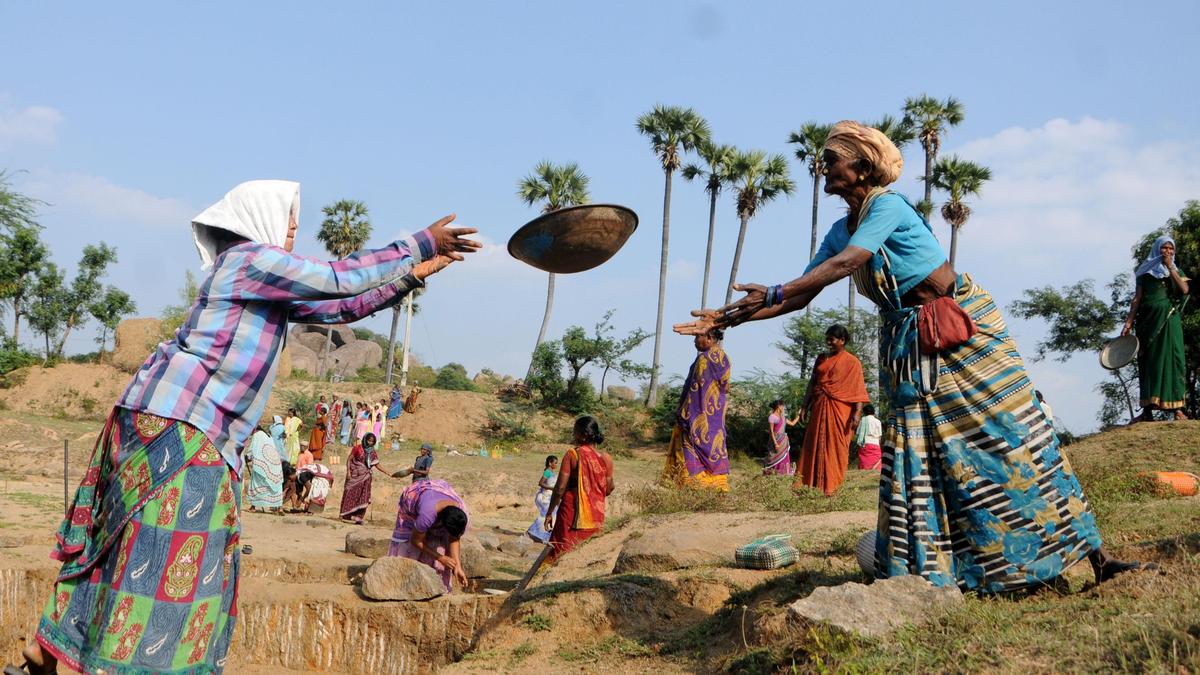
The historic Mahatma Gandhi National Rural Employment Guarantee Act (MGNREGA) became a reality on September 5, 2005, during the first tenure of Dr. Manmohan Singh as Prime Minister. MGNREGA was a rights-based legislation inspired by Article 41 of the Constitution of India, which calls upon the Government to secure citizens’ right to work. It was developed and given shape through an extensive process of public consultations that lasted for almost 13 months. Both Houses of Parliament passed the Bill. both enthusiastically and unanimously.
Over the past few days, the Narendra Modi government worked to bulldoze MGNREGA’s abolition without any discussion, consultation, or respect for parliamentary processes or Centre-State relations. The removal of the Mahatma’s name was only the tip of the iceberg. The very structure of MGNREGA, so integral to its impact, has been annihilated. It must be recalled that it has been the world’s largest social security initiative and one that has also been the most intensively studied and evaluated. All these studies have emphasised its transformative effects on the weakest sections of our society.
Also read | VB-G RAM G replaces MGNREGA: Cutting off a rural lifeline and the Directive Principles
A demolition in stages
Right from its conception, MGNREGA was envisioned as more than a mere scheme — as guaranteed employment based on actual demand from rural families in distress. The Modi government has simply annihilated the very idea of a legal guarantee in its new law, which is nothing but a set of bureaucratic provisions.
MGNREGA enacted the right to work in all rural India. The Modi government’s new Bill has restricted the ambit of the scheme to rural areas as notified by the Union at its discretion.
Whereas earlier, the central allocation was meant to be uncapped, there is now a pre-determined budgetary allocation that caps the days of employment provided in each State. The number of workdays provided are, therefore, left to the Union Government’s priorities rather than the people’s needs.
The all-year guarantee of employment has been finished off. State governments have been asked to identify 60 days during peak agricultural season where no work shall be undertaken. One of the greatest impacts of MGNREGA was to increase the bargaining power of the landless poor in rural India, which has elevated agricultural wages. This bargaining power will definitely be eroded under the new law. The Modi government is attempting to suppress wage growth and that too at a time when the proportion of employment in agriculture has risen for the first time since Independence, contrary to what should have been the case.
MGNREGA exempted State governments from most of the financial burden, since the cost-sharing ratio was 90:10, borne by the Union government. This incentivised the State government to implement the scheme in earnest, in response to demand rather than its own fiscal constraints. Now, the new cost-sharing ratio is 60:40. Worse, any expense incurred in excess of the Union government’s pre-determined allocation will now have to be borne entirely by the States. Effectively, by transferring a significant portion of the expense onto the States, the Modi government is discouraging States from providing work under the scheme. The finances of States, already under severe stress and strain, will be further devastated.
Aside from demolishing the demand-based nature of the programme, the Modi government has ended the decentralised nature of the scheme. In accordance with the 73rd Constitutional Amendment, MGNREGA provided for the Gram Sabha to undertake the planning of works as well as be the principal implementation authority of the scheme. This constitutional vision of local self-governance will be replaced by a top-down PM GatiShakti National Master Plan (PMGS-NMP) which will inevitably reflect the Union government’s priorities rather than local needs. This is centralisation with a vengeance.
The Modi government is resorting to fraudulent claims that it has enhanced the employment guarantee from 100 days (under MGNREGA) to 125 days. For all the reasons outlined above, that will certainly not be the case. Indeed, the real nature of the Modi government’s intentions can be understood from its decade-long track record of throttling MGNREGA. It began with the Prime Minister’s (in)famous mocking of the scheme on the floor of the House and proceeded apace through a ‘death by a thousand cuts’ strategy — through, for instance, stagnant budgets, the use of disenfranchising technology and delayed payments to workers.
The impact of its loss
For the last 20 years, MGNREGA has been the most powerful social security intervention at the disposal of the government. It has secured better wages for crores of citizens, stemmed seasonal distress migration, and hugely empowered gram panchayats. The social audits conducted by the gram sabhas brought about a new culture of accountability and transparency. During the COVID-19 pandemic, when the whole economy was severely dislocated, MGNREGA was one of two avenues through which the government was able to reach the poor and most vulnerable sections of society — the other being the National Food Security Act, 2013. Outside of COVID-19, the ever-high demand for work under this scheme only proves its continued necessity for ensuring rural livelihoods. Its demolition will have catastrophic consequences for crores of people across rural India.
In cross hairs
The demolition of the right to work must not be seen in isolation but as part of the long assault by the ruling establishment on the Constitution and its right-based vision for the country. The most fundamental right to vote is under unprecedented assault. The Right to Information has been desecrated with legislative changes that weaken the autonomy of Information Commissioners, and by wholesale exemptions from the Act for ill-defined ‘personal information’ data. The Right to Education has been undermined by a National Education Policy 2020, which has legitimised the shut down of about one lakh primary schools around the country. The Forest Rights Act, 2006, was markedly weakened by the Forest (Conservation) Rules (2022) which removed the gram sabha from any role in permitting the diversion of forest land. The Right to Fair Compensation and Transparency in Land Acquisition, Rehabilitation and Resettlement Act, 2013 has been significantly diluted. The National Green Tribunal set up in October 2010 following the passage of the National Green Tribunal Act, 2010 has been emasculated. Through the three black farm laws, the government attempted to deny farmers the right to a minimum support price. The National Food Security Act, 2013, may very well be next on the chopping block.
MGNREGA realised the Mahatma’s vision of Sarvodaya (‘welfare of all’) and enacted the constitutional right to work. Its death is our collective moral failure — one that will have financial and human consequences for crores of India’s working peoples for years to come. It is imperative, now more than ever, to unite and safeguard the rights that protect us all.
Sonia Gandhi is Chairperson, Congress Parliamentary Party
Published – December 22, 2025 12:16 am IST












Publicar comentário