Hawaiian Language Schools Grow As DOE Shrinks. There’s One Big Problem
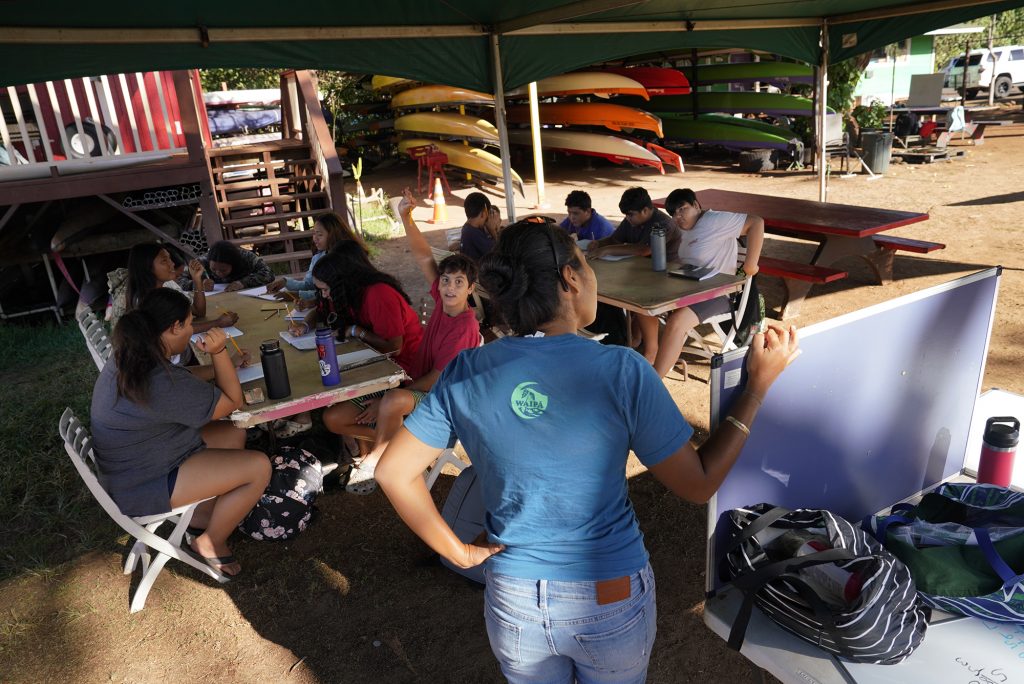
At a time when local schools are facing shrinking enrollment and talks of closure, Hawaiian immersion programs are bucking the trend.
Enrollment in schools that teach primarily in ʻōlelo Hawaiʻi — collectively known as Kaiapuni schools — has increased by 68% over the past decade, with the number of campuses run by the state education department growing from 14 to 26. But students tend to have fewer immersion options in middle and high school, and the pool of qualified teachers isn’t keeping up with families’ growing demand.
Recruiting qualified teachers is one of the largest barriers to expanding Kaiapuni programs, Office of Hawaiian Education Director Kau‘i Sang said in a recent education board meeting. The Department of Education needs to find a balance between adding more classrooms to meet families’ needs and hiring enough teachers to support existing Kaiapuni schools, she said.
DOE plans on opening two new Kaiapuni programs at Haleʻiwa Elementary on Oʻahu and Kalanianaʻole Elementary on the Big Island.
“We cannot open classrooms unless we have qualified staff,” Sang said.
Currently, DOE has three unfilled Kaiapuni teacher positions, Communications Director Nanea Ching said in an emailed statement. The department also employs 25 unlicensed Kaiapuni educators who still need to fulfill their teacher training requirements, she said.
But the number of additional teachers needed to fully staff Kaiapuni schools could be closer to 100, said Kananinohea Mākaʻimoku, an associate professor at the University of Hawaiʻi Hilo’s College of Hawaiian Language. Some Kaiapuni teachers are taking on larger-than-average class sizes because of staffing shortages, she said, meaning the annual vacancy rates underestimate the number of educators schools need.
DOE will need 165 more Kaiapuni teachers in the next decade to fully staff its classrooms and meet families’ growing demand, according to ʻAha Kauleo, an advisory group of Hawaiian language schools and organizations. The projection doesn’t account for a large group of teachers who are expected to retire in the coming years, Mākaʻimoku said.
Last year, UH Mānoa and Hilo produced a total of 12 licensed Kaiapuni teachers.
It’s difficult to find candidates who are both fluent in Hawaiian and interested in teaching, Mākaʻimoku said, especially because Hawaiian language speakers are in high demand in many careers. But a lack of teachers doesn’t mean schools should stop expanding Kaiapuni programs, she said, especially when the movement has so much family support and momentum.
‘No Option But To Leave Their Home District’
The Hawaiʻi Supreme Court has previously ruled that the education department has a constitutional duty to provide families with access to Hawaiian immersion education. Two lawsuits filed in August argued that DOE has fallen short of this responsibility by creating unique barriers for immersion families, such as waitlists for enrollment and limited immersion programs in some school districts.
One of the lawsuits was dropped over the summer, but the second remains active.
Currently, families are pushing for more immersion options in Pearl City, which has no middle or high school for Kaiapuni students. Children can attend the Kaiapuni program at Waiau Elementary until the sixth grade but then need to transfer to immersion programs in Kapolei or Honolulu for middle school or switch to an English-language program.
A petition to add Kaiapuni programs at Highlands Intermediate and Pearl City High School received more than 100 signatures over the past three weeks.
“Our keiki start their educational journey in Hawaiian immersion programs, but upon reaching intermediate and high school levels, they find themselves with no option but to leave their home district,” parent Chloe Puaʻena Vierra-Villanueva said in written testimony to the Board of Education.
The department is planning to add more grade levels to existing Kaiapuni schools next year and provide families with more information on how to enroll in immersion programs, Sang said. Her office also plans on tracking the number of open seats and waitlists across the state to determine which communities have the greatest demand for Kaiapuni classrooms.
Since 2020, the state has also offered a $8,000 salary bonus to Kaiapuni teachers to attract more people to classroom positions.
Kahea Faria, an assistant specialist at UH Mānoa’s College of Education and a Kaiapuni parent, said she would like to see more DOE campuses solely dedicated to serving immersion students across all grade levels. Creating environments where Hawaiian is the only spoken language is critical to students’ development, she said, and could possibly encourage more kids to pursue teaching careers in Kaiapuni schools.
“Right now, with a growing number of students, they have very limited opportunities to grow their language abilities,” Faria said.
The state also needs to look beyond Kaiapuni graduates to expand the potential pool of immersion teachers, Mākaʻimoku said. For example, she said, offering more Hawaiian language classes to families and community members could encourage more people to earn their Kaiapuni teaching credentials.
“That’s definitely a conversation that all communities in Hawaiʻi should have,” she said.
Civil Beat’s education reporting is supported by a grant from Chamberlin Family Philanthropy.

Sign up for our FREE morning newsletter and face each day more informed.












Publicar comentário