The Best World Timer Watches We’ve Reviewed After a Decade of Testing
We’ve spent the past decade fiddling with crowns, swapping straps on spring bars, and wearing world timer watches into cafes, airports, and random weekend barbecues because let’s face it: most world timers never leave the display case. After hands-on review-wear (yes, scuffs included), we asked ourselves: When the hour ring rotates and the city ring spins, what matters on your wrist? The truth is, the best world timers are the ones you’ll reach for on a Tuesday afternoon, not only before a flight or for an Instagram reel.
From the playful details on the Farer Roché II to the bright glow of the C1 Worldglow and the easygoing design of the Nomos Zürich World Time, and with a nod to the revived Rado Over-Pole, these watches earned their spot because we used them in daily life rather than treating them like display pieces. If you’re looking for “best world timers,” this is where we walk you through the ones that genuinely stood out.
Farer World Timer Roché II

| Price: | $1,695 (leather strap) $1,865 (stainless steel bracelet) |
| Water Resistance: | 100m |
| Case Dimensions: | 39mm (diameter) x 45mm (lug-to-lug) x 11mm (thickness) |
| Lug Width: | 20mm |
| Movement: | Sellita SW330-1 Elaboré |
The Farer World Timer Roché II is the rare world timer that feels built for everyday use, not just for travel. The 39 millimeter case hits a wearable middle ground and feels solid without weighing you down. We found that during our hands-on review, it sat flat on all our wrists and moved cleanly under sleeves during office days, coffee runs, and a couple of chaotic airport dashes. The 100-meter water resistance also allowed us to treat it like a regular watch rather than something that panics around a faucet. That practicality alone made it stand out from the usual “desk globe” world timers we test.
The dial is where the Roché II earns its personality. The midnight-blue surface features a textured pattern that pulls in the right amount of light to keep the rotating 24-city ring easy to track. The Super Luminova lume is generous. The hands, the markers, and the entire inner bezel glow. It looks dramatic at first, but it proved helpful during late-night work sessions and early flights. The updated alpha handset is sharp and easy to read, and the raised markers add depth without crowding the dial. Farer’s rotating 24-hour disc felt more intuitive than expected. It let us quickly check another time zone, and the modified Sellita SW330 remained stable throughout testing. The small bump to 50 hours of power reserve gave us more flexibility when rotating watches during the week.
Comfort might be the Roché II’s quietest strength. The St. Venere leather strap felt soft from day one and stayed secure even on smaller wrists. The quick-release setup makes swaps painless. The bracelet option adds a little heft if that is your preference. After wearing it in a mix of typical, non-glamorous scenarios, the watch came across as a world timer with real charm and solid daily practicality. It is not the cheapest option out there, but the finishing, lume work, and thoughtful complications make it feel like a good fit for enthusiasts who want something playful and capable.
Pros
- Textured blue dial improves legibility and highlights the city ring.
- Extensive lume is helpful in low light.
- Modified SW330 movement offers a stable 50-hour power reserve.
- Comfortable and easy to swap the St. Venere strap.
Cons
- Price sits above many microbrand alternatives.
- The inner bezel takes a moment to learn the first time.
- Dial design may feel busy for minimalists.
Christopher Ward C1 Worldglow

| Price Range: | $1,995 |
| Water Resistance: | 30m |
| Case Dimensions: | 43.5mm (diameter) x 51.9mm (lug-to-lug) x 11.55mm (thickness) |
| Lug Width: | 22mm |
| Movement: | Sellita SW300 with CW’s in-house JJ03 module |
The Christopher Ward C1 Worldglow is one of those watches that tries to blend dress-watch polish with world-timer function, and you feel that tension the moment it hits your wrist. The case looks sharp with its long lugs, mirrored surfaces, and a scalloped bezel that gives the watch a layered look. It wears flatter than its 11.55 millimeter height suggests, although the 43.5 millimeter width still pushed out toward the edges of some of our smaller wrists. The domed crystal is clean and distortion-free, so checking the dial straight on feels natural. It gives the watch a refined presence, the kind you notice more in quieter settings like a dinner out or a work meeting.
The dial shifts the vibe completely. Everything is black and white, almost tuxedo-formal, with a large world map and a rotating hour ring that handles time zone changes. It looks crisp, but it is busy, and several of us needed a couple of days before reading the local time felt instinctive. The lume is the headline feature here, and it is bright enough that a quick charge in a living room left things glowing. After sunlight, it lights up like a small lamp. The catch is that the parts you need to read the actual time are dimmer than the glowing dial. During testing, it left our review team hunting for the hour hand more often than expected. The Sellita SW300 with CW’s JJ03 module handled the world-time adjustments smoothly. During our testing of the watch, jumping between zones felt intuitive once we got the pattern down, even if the system still felt more technical than everyday.
The leather strap is soft out of the box, and the Bader deployant gives it a clean, tucked look. It is a thicker setup, and the clasp picked up marks quickly during office use. The Milanese option leans more toward casual or sporty wear. After wearing the Worldglow to a mix of work events and weekend nights out, the watch came across as a dressy world timer that prioritizes visual impact over quick readability. If you love lume and want a bold piece for formal settings, it has real charm. If you need a daily world timer for glances, the brightness feels more like a novelty than a tool.
Pros
- The bright, even lume creates a striking nighttime look.
- Smooth world time adjustments through the JJ03 module.
- Polished case and domed crystal deliver a refined wrist presence.
Cons
- Large case size can overwhelm smaller wrists.
- Lume on the time-keeping elements is weaker than the dial.
- Dial layout takes time to learn for quick reads.
Rado Over-Pole

| Price: | $2,400 |
| Water Resistance: | 100m |
| Case Dimensions: | 37mm (diameter) x 43mm (lug-to-lug) x 10.4mm (thickness) |
| Lug Width: | 19mm |
| Movement: | Rado R862 |
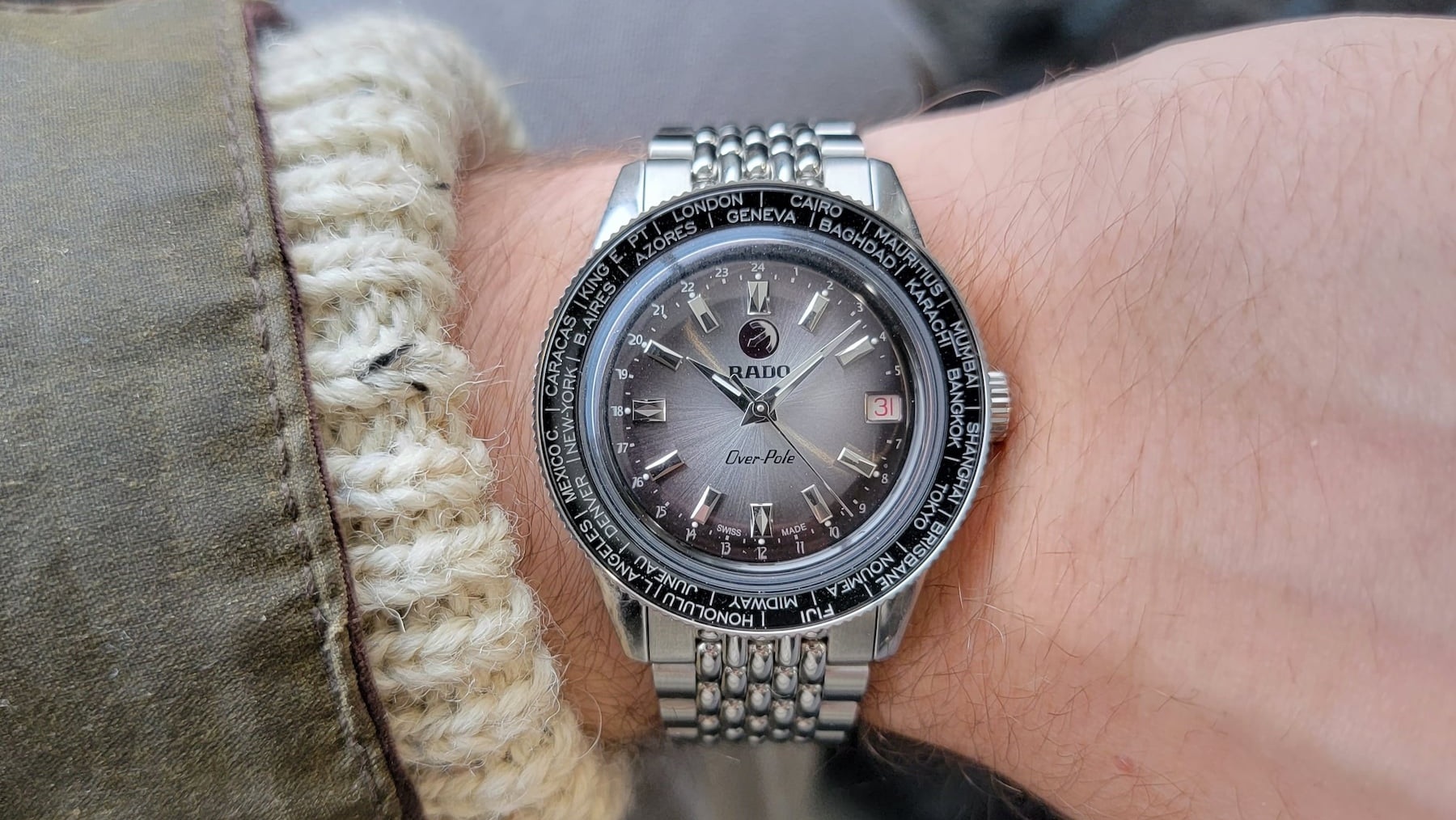
The Rado Over-Pole, re-released as a limited edition, is a nostalgic piece that doesn’t feel fragile or fussy on the wrist. The 37mm case sits low and balanced, and its slim appearance makes it easy to wear through a typical workday. It still has a dressy presence thanks to the full polish, though that also means it picks up fingerprints quickly. The manually wound R862 movement gives the watch a slower, more deliberate rhythm. Several of us enjoyed that ritual in the morning because it made the watch feel more personal. The long 80-hour power reserve also meant we could skip a day without having to return to a dead movement. It behaved reliably and looked good on the display back, with its tidy finish.
The dial and bezel carry most of the watch’s character. The concave ceramic bezel looks sharp with its laser-engraved cities, though glare occasionally made reading it tricky. This happened most often under overhead office lighting or when sitting in front of a laptop. The gray gradient dial has a subtle metallic shine that never feels loud. The applied indices bring a surprising sense of depth and make the watch feel more upscale than many vintage-inspired releases. We all liked the red date text because it added a dash of personality without breaking the design intent. However, nighttime use is the weak point. The lume is minimal and barely visible, so it is not the watch you reach for when you need quick reads after dark.
Rado includes both a leather strap and a rice-bead bracelet. The bracelet stood out for comfort and stayed planted even on smaller wrists. The lack of micro adjustment was noticeable on warmer days, though never enough to make it unwearable. The leather strap felt solid but leaned dressy. Overall, it is not a budget pick, but it offers a mix of world time functionality and vintage charm that is tough to find elsewhere. For a deeper dive into our personal experiences, explore our in-depth review.
Pros
- Comfortable 37mm case with a slim profile.
- Unique concave ceramic bezel and well-executed dial details.
- Hand-wound movement with an 80-hour reserve.
- The bracelet is extremely comfortable.
Cons
- Lume is minimal and not practical for nighttime use.
- Fully polished surfaces show wear and tear easily.
- Bezel legibility suffers under glare.
Nomos Zürich World Time

| Price: | $6,100 |
| Water Resistance: | 30m |
| Case Dimensions: | 40mm (diameter) x 50mm (lug-to-lug) x 11mm (thickness) |
| Lug Width: | 20mm |
| Movement: | DUW 5201 |
The Nomos Zürich World Time is one of those watches that looks almost overly restrained in photos, then shows far more personality once you wear it. The blue dial adds a quiet depth that shifts between navy and steel depending on the light. It stays calm and matte, so it never competes with the city ring or the rhodium hands. As discussed in our review, several of us noticed how the red home-time indicator popped just enough to stay visible whether we were indoors or walking through an airport concourse. The whole layout is clean and intentional, and it feels like Nomos built it for people who want function without clutter.
Where the watch earns its keep is how it handles travel. The pusher at two o’clock jumps the local hour forward one click at a time, while home time stays anchored on the small 24-hour subdial. We tried it during a short regional trip, and it took seconds to reset. No crown fiddling. No multi-step process. Simply tap and go. The in-house DUW 5201 movement remained steady throughout the trip and closely matched its claimed power reserve of 42 hours. The 40mm case wears slim, although the long lugs give it a larger footprint. On medium wrists, it looked refined. But, on smaller wrists, it started to drift toward oversize territory. The polished case also picked up micro-scratches faster than expected, so it is worth treating it more like a dress piece than an everyday beater.
Comfort comes from the usual Nomos setup. The shell cordovan strap sits nicely and stays put through a full day of wear. What surprised us is how modern the watch feels on the wrist despite its simple layout. It is technically closer to a GMT than a full world timer, but the design still gives plenty of visual depth. After having it on our wrists, the Zürich felt like a world time adjacent piece for people who appreciate clean design and want a unique complication that does not scream for attention.
Pros
- Clean and legible dial with a subtle blue gradient.
- A single pusher makes quick local time changes during travel.
- In-house DUW 5201 movement with steady performance.
- Striking and uncommon design in daily wear.
Cons
- Long lugs limit compatibility with smaller wrists.
- Low water resistance makes it a strictly dress-oriented piece.
- The fully polished case shows wear easily.
- More GMT than true world timer in practice.
Please let us know your thoughts on our picks in the comments below. Also, if there are any pieces you feel are missing from here, please let us know and we’ll see if we can work to get it in for review.

Co-Founder and Senior Editor
Kaz has been collecting watches since 2015, but he’s been fascinated by product design, the Collector’s psychology, and brand marketing his whole life. While sharing the same strong fondness for all things horologically-affordable as Mike (his TBWS partner in crime), Kaz’s collection niche is also focused on vintage Soviet watches as well as watches that feature a unique, but well-designed quirk or visual hook.













Publicar comentário