Trae Young potential trade spots: Clippers? Wizards? Plus, 4 that don’t line up
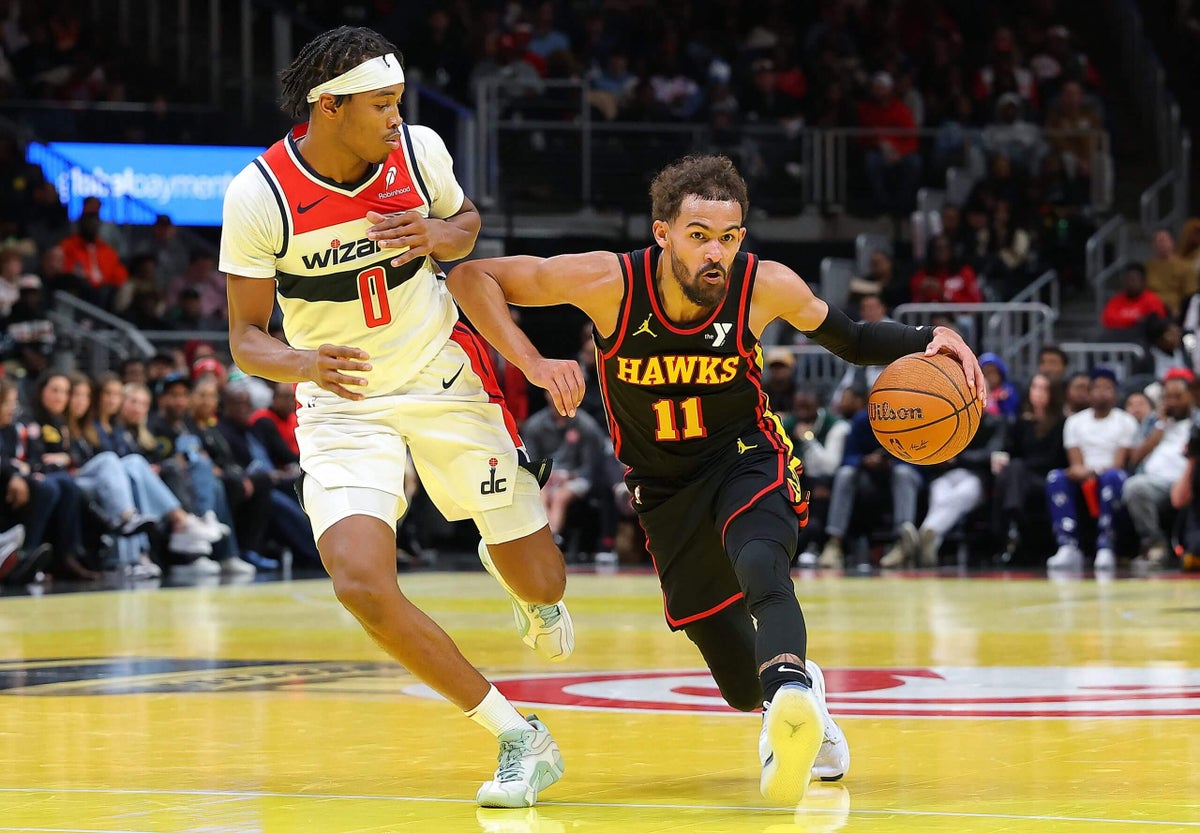
It seems like the Trae Young era in Atlanta is coming to an end.
League sources told The Athletic on Monday evening that the Hawks and Young are working to find a new home for the lead guard before the Feb. 5 trade deadline, an outcome that makes sense for everyone involved. The Hawks have been at their best this season playing larger and longer across the backcourt while empowering Jalen Johnson and other wings like him to play on the ball. Atlanta can put Young’s $45 million salary slot to use this season and would have even better use for his potential $49 million salary slot next summer.
If Young and Kristaps Porziņģis’s expiring salaries both came off the books in the summer of 2026, the Hawks could set themselves up as a potential power in the Eastern Conference. They would have only $107.5 million committed to eight players and also own the New Orleans Pelicans’ unprotected first-round pick that is currently tied for the top odds to be the No. 1 pick in a loaded 2026 NBA Draft class. Atlanta could have in the vicinity of $45 million-$50 million in cap space on top of access to a player like Darryn Peterson, AJ Dybantsa or Cameron Boozer.
The question that I’ve received from sources around the NBA has not been whether Atlanta should trade him, but which team would be interested in paying Young moving forward. Undeniably, Young is a skilled player who can take on an immense offensive load. Before this injury-riddled 16-game season so far, he averaged 26.5 points per game and 10.2 assists over the previous six seasons. He’s arguably the best ball-screen passer in the NBA, a maestro who can find teammates from any position on the court from a live dribble. He also has a multi-level scoring game thanks to his pull-up shooting gravity and his deft floater game.
Unfortunately, he’s also a flawed player in this NBA era. Young has never really developed consistency in playing off the ball and tends to float along the perimeter when he doesn’t have it in his hands. While Young shot about 44 percent from the field and 36 percent from 3 on a difficult shot diet from 2020 to 2024, he has made only 41 percent of his field-goal attempts and 33 percent of his 3s the last two years. Essentially, Young shot the ball 3 percent above league average in terms of true-shooting percentage from 2020 to 2024 but has been 2 percent below league average since. And that’s before we get to Young’s defense, which has always left a lot to be desired because of his lack of size and strength.
The teams mentioned the most for Young when I’ve asked around the league tend to be either rebuilding ones looking for solid point guard play to help develop the rest of their roster or teams that simply need more scoring punch and have strong enough defensive infrastructure to make up for Young’s deficiencies. Rarely does the discussion of trading Young include much coming back to Atlanta in terms of draft-pick value.
Here, I’ll present a few options that could make sense for Young and the Hawks as they look to move on from one another:
Trade to the Wizards for expiring money
Washington Wizards receive: Young
Hawks receive: C.J. McCollum, Corey Kispert, 2026 Oklahoma City first-round pick, two second-round picks
The case for/against the Wizards: The Wizards (9-25) are rebuilding and have an intriguing blend of young wings, including Tre Johnson, Kyshawn George and Bilal Coulibaly, on top of impressive second-year center Alex Sarr. The addition of Young could supercharge their developmental process, as Washington lacks an organizational presence at the lead guard spot. McCollum is more of a perimeter-based scoring guard. Khris Middleton doesn’t collapse defenses at this stage of his career.
Young would give them a player who could put paint pressure on opposing teams in a way that the Wizards lack. Washington very rarely gets to the foul line and generally turns the ball over too often. Despite Young’s propensity for turnovers, his teams are generally highly rated in offensive turnover rate. The Wizards are also 21st in the NBA in assist rate; Young’s ability to collapse defenses and make high-level kickout reads or lobs would help.
Washington’s wings would be quite complementary to Young because of their shooting ability, and Sarr would work well as a pick-and-roll partner. Sarr thrives in short-roll situations; that’s a skill that a team employing Young needs, because opposing defenses often blitz Young either with two players in screens or by playing at the level to account for his pull-up gravity. Possessing a release valve like Sarr who can take advantage of bent defenses would be immensely valuable. The Wizards also don’t have much use for what will likely be the No. 30 pick in the draft, given the number of young players they already have on the roster as well as the future picks they have incoming.
Why would the Wizards not do this? Well, Washington has the 29th-ranked defense in the NBA, and acquiring Young would certainly make life more difficult on that end long-term. The Wizards’ guards already struggle to get through ball screens, and that’s an area where Young’s lack of size and strength poses structural issues. Still, I think that with Coulibaly, George and Sarr around, this is the kind of team that could have a chance to mitigate Young’s length issues.
The case for the Hawks doing this deal: The Hawks simply get off Young’s money for next year while also acquiring a late first, a couple of seconds and a good rotational shooting wing in Kispert that they could likely forward on to a third team if they needed the space. McCollum would give them scoring punch in the backcourt this year and work well with the rest of the team to replace the half-court firepower they need without Young. McCollum is averaging nearly 19 points per game while shooting 45 percent from the field and 39 percent from 3, basically in line with his career averages.
I’ve always been partial to Kispert as a solid rotational wing who can knock down shots, cut off the ball and be an unselfish offensive presence who takes advantage of what’s presented. Over his last four years, he’s averaged 11.8 points while shooting 48 percent from the field, 39 percent from 3 and 79 percent from the line in nearly 250 games. He picks and chooses his spots well and would help Atlanta if they wanted to keep him. Even if they didn’t and preferred the space, Kispert is the kind of player that a team like the Detroit Pistons, for example, would likely take for free into their $14.1 million trade exception to help their floor spacing around Cade Cunningham.
This deal would give the Hawks about $32 million-$38 million in cap space with nine players plus the Pelicans’ first-round pick under contract, accomplishing their goal of retaining flexibility while adding some draft capital.
Hawks cash in flexibility in three-team deal
Wizards receive: Young
Hawks receive: Anthony Davis, Dwight Powell
Dallas Mavericks receive: McCollum, Zaccharie Risacher, Kispert, 2032 unprotected Hawks first-round pick

The case for the Mavericks: I’m sure the Pelicans’ pick would be the Mavs’ opening bargaining position in a Davis deal with the Hawks. They’re not going to get that pick. Instead, they get McCollum’s expiring deal, Kispert, an unprotected first-round pick far out into the future and take the flyer on Risacher, the former No. 1 pick who has regressed this season but presents as a perfect complement to Cooper Flagg on the wing long-term.
Risacher is not a particularly explosive or forceful athlete, but he’s very skilled for his size at nearly 6-foot-9. After finishing second in Rookie of the Year voting last year, he has not stepped up this season to pick up the slack for Young’s half-court creation in the games that Young has missed. Risacher is averaging 10.6 points, three rebounds and 1.4 assists while shooting 44.9 percent from the field and 33.1 percent from 3. Risacher has always been a streaky shooter, having gone on long stretches making under 30 percent from distance and then other long stretches making 45 percent from 3, and that dates back to both his pre-draft year and his rookie season.
Risacher’s best contributions do not always show up in the box score, as he’s a sharp team defender who is always conscientious about helping the helper and making sure he’s rotationally sound, on top of being a good cutter who occupies defenders for his teammates. Still, he hasn’t been nearly productive or efficient enough this season, and he needs to become a more diligent rebounder and on-ball defender while ironing out his shooting consistency. I would not have considered drafting him No. 1 in 2024, so I’m probably a bit lower on him than the Hawks (although this is a different front office leadership group than the one who selected him). I’d probably be willing to include him in a deal for the right player, even though I believe in his potential as a starting quality player in the Jabari Smith Jr. mold.
This deal would bring the Mavericks’ return for Luka Dončić, in total, to McCollum, Risacher, Kispert, Max Christie and three first-round picks. Is that enough for Dončić? Absolutely not. But at least it looks a little bit better.
The real question is whether Davis is the right player for the Hawks. That’s a good question worth exploring.
The case for/against the Hawks: I’m not quite as high on the idea of the Hawks utilizing some of their assets and completely minimizing their flexibility this summer to acquire Davis right now. But there is a case for it. On the plus side, Davis would transform the Hawks’ defense. It’s hard to imagine a better dual-big combination than Davis and Porziņģis; Porziņģis could space the court on the perimeter on offense and hold down the interior on defense, while Davis plays in ball screens offensively with Atlanta’s guards and then wreaks havoc on the weak side with his length on defense. As the NBA sizes up, that would be a fun combination for the rest of the year. You could say similar things about Davis-Onyeka Okongwu combinations, or you could go smaller with Davis at the five and Jalen Johnson at the four.
The Hawks would have lineup flexibility that would allow them to maintain high-level defensive play. Such a back line on defense would also weaponize Dyson Daniels even more on the perimeter to gamble with his disruption on ballhandlers, knowing that he has a real presence behind him. Then next year, the Hawks could continue to have big and small looks with Okongwu-Davis combinations or Davis-Johnson combos, while staying under the cap and looking to use their mid-level exception to acquire a scoring guard who makes sense for them (if they don’t hit the lottery and end up with Kansas guard Darryn Peterson with that Pelicans’ pick).
Davis remains a tremendous player. He’s averaging 20 points and 10.8 rebounds per game while shooting 52 percent from the field and tossing up nearly three steals or blocks per game. He’s active on defense, fluid and mobile across both ball screens and in help defense. Offensively, he’s still excellent with his face-up game and is sharp as a partner in ball screens.
I just wouldn’t feel great about betting on Davis’ health when the alternative is having flexibility to get younger players in the summer who better fit the team’s timeline. Johnson is still only 24. Okongwu just turned 25. Daniels is 22. Nickeil Alexander-Walker is 27, and I remain reasonably high on 23-year-old backup Mo Gueye. They’ll be joined by an elite draft pick who will likely be a teenager. I’m not sure that giving up real assets and adding a nearly 33-year-old Davis maximizes their window. The alternatives in free agency could be something like keeping Risacher and the future pick and then signing 26-year-old Coby White and 28-year-old Mitchell Robinson. Or signing 28-year-old Isaiah Hartenstein and 26-year-old Quentin Grimes. All those players are unrestricted free agents. I think I’d rather pursue those pathways if I were the Hawks.
Life in LA with the Clippers
LA Clippers receive: Young
Hawks receive: John Collins, Bogdan Bogdanović, Kobe Brown, 2030 Clippers’ lottery-protected first-round pick

The case for the Clippers: LA’s offense falls off a cliff when James Harden leaves the court this year. Per Databallr, when Harden is on the court, the Clippers put up an offensive rating of 121.2. That would be equivalent to the fifth-best offense in the NBA this season. When he’s off the court, they put up an offensive rating of 106.5, a number that would be dead last in the NBA by more than two points per 100 possessions. By acquiring Young and staggering him with Harden, the team would have a competent point guard out there at all times and could end up making the Play-In Tournament just through that alone. Yes, the fit with Harden is not ideal by any stretch when they’re both on the court. But if you staggered them correctly, that would only need to occur for about 12 to 15 minutes per game.
If the Clippers went down that road, they would want Young to opt in to his player option upon being acquired. The reason is that it would set up their 2026-27 in an interesting way. Harden has a player option for 2025-26 that is locked in for only $13 million guaranteed. At 27, Young would be a natural heir apparent to Harden and would allow the Clippers to continue to play the two timelines card.
The Clippers are set up to have major cap space in the summer of 2027, with only Ivica Zubac’s $21 million locked in on their books. Having Young under contract for the 2026-27 season before hitting unrestricted free agency would give them a lot of flexibility both this summer and next summer when Kawhi Leonard and Young would come off the books. The team could look to try to retain Young and Leonard for around $100 million if they’re both still worth that money and then still have $40 million-plus in cap space. Or the Clippers could retain only Young with Zubac for around $60 million-$70 million total if Leonard’s health fails and still be in a positive position to reshape the roster. Or they could simply move on from Young.
With Steve Ballmer’s money, what is reputed to be the best medical team in the NBA, a well-respected front office, a new high-end arena, and a sunny Los Angeles zip code, the Clippers could easily pivot into a positive situation.
The case for the Hawks: This deal would make sense for the Hawks under two conditions. The first is if nobody else offers anything of value for Young and instead demands that the Hawks give them value back in a deal. I think they can probably find a trade where that doesn’t happen. Second, if the Hawks decide that they only want expiring money for Young, it’s hard to find a better situation than this one. Collins and Brown are expiring contracts, and Bogdanović has a team option for next season with zero money guaranteed. That would allow the Hawks to maximize their flexibility in the summer while adding a high-value draft pick.
Four options I don’t think make sense
Toronto Raptors receive: Young, Luke Kennard
Hawks receive: Immanuel Quickley, RJ Barrett, two future first-round picks
Why this doesn’t make sense for anyone: The Raptors are going to be brought up any time that a star offensive player — particularly a guard — is available. To make the salaries work, a Toronto deal would essentially have to involve both Quickley and Barrett unless the team was willing to give up three of its young players. For the Hawks, that doesn’t work even if the Raptors threw in two future first-rounders (a price that would be required to get off the Quickley deal, which has three years left after this one at nearly $100 million total) because it would tank the Hawks’ flexibility this summer.
For the Raptors, giving up multiple picks for Young is a bad plan. The team has finally figured out its defensive identity this season, in part by playing high-pressure point-of-attack defense. Young does not fit that paradigm.
Phoenix Suns receive: Young
Hawks receive: Jalen Green, Royce O’Neale, Khaman Maluach
Why this doesn’t make sense: I can understand why the Suns would look into Young as an interesting partner for Booker. He’d shift Booker more consistently off the ball and give them another dynamic option as a playmaker. First-year coach Jordan Ott has been terrific so far and has great experience with a two-headed monster in the backcourt from his days in Cleveland. He could probably get the most out of a Young-Booker combination.
But similar to what is discussed above, the Hawks would ruin their flexibility this summer by acquiring Green and O’Neale. I think they’re can do better than that in free agency or in trades where they take back salary this summer. The prize for doing this would be getting Maluach, who is a terrific young defensive center drafted No. 10 last year. I just don’t think he’s worth giving up all of Atlanta’s flexibility.
Minnesota Timberwolves receive: Young
Hawks receive: Naz Reid, Donte DiVincenzo, Mike Conley, Leonard Miller
Why this doesn’t make sense: Anytime a point guard’s name comes up, the Wolves will get mentioned. But this one doesn’t work because of how much Young makes. Unless Minnesota is willing to complete a five-for-one trade in the middle of the season or include Jaden McDaniels in a deal — two ideas that seem highly unlikely, bordering on stupid — the only construction that works under salary matching rules involves Reid, DiVincenzo and Conley with a minimum-salaried player. For what would ostensibly be a win-now move, that feels like a lot of depth to give up for Young. The Wolves would then likely be relying on minutes from Rob Dillingham or Bones Hyland in a playoff series, on top of needing real minutes from raw rookie Joan Beringer at the backup center position. I also don’t like the idea of taking the ball out of Anthony Edwards’ hands, given how successful he’s been in the playoffs. Minnesota’s best bet at the point guard position remains someone who can play both on and off the ball.
For the Hawks, it again comes down to flexibility. Reid and DiVincenzo are good players, but Atlanta might be able to do better.
Sacramento Kings receive: Young
Hawks receive: Zach LaVine, Devin Carter, a future first-round pick
Why this doesn’t make sense: The Athletic’s Sam Amick has already reported that the Kings aren’t interested, but it’s worth noting why a few sources on other teams have speculated to me that Sacramento could make sense. This would seem to be rearranging deck chairs on the Titanic for the Kings, acquiring one ball-dominant player for another score-first, on-ball option. Young is indeed a better player than LaVine, which is why the Kings would be required to add here. But I don’t think Sacramento becomes better enough to sacrifice that future value.
For the Hawks, I don’t think the juice is worth the squeeze. LaVine doesn’t fit their age timeline, and the other assets aren’t good enough if the other option is merely getting cap space from either the Clippers or Wizards.










Publicar comentário